
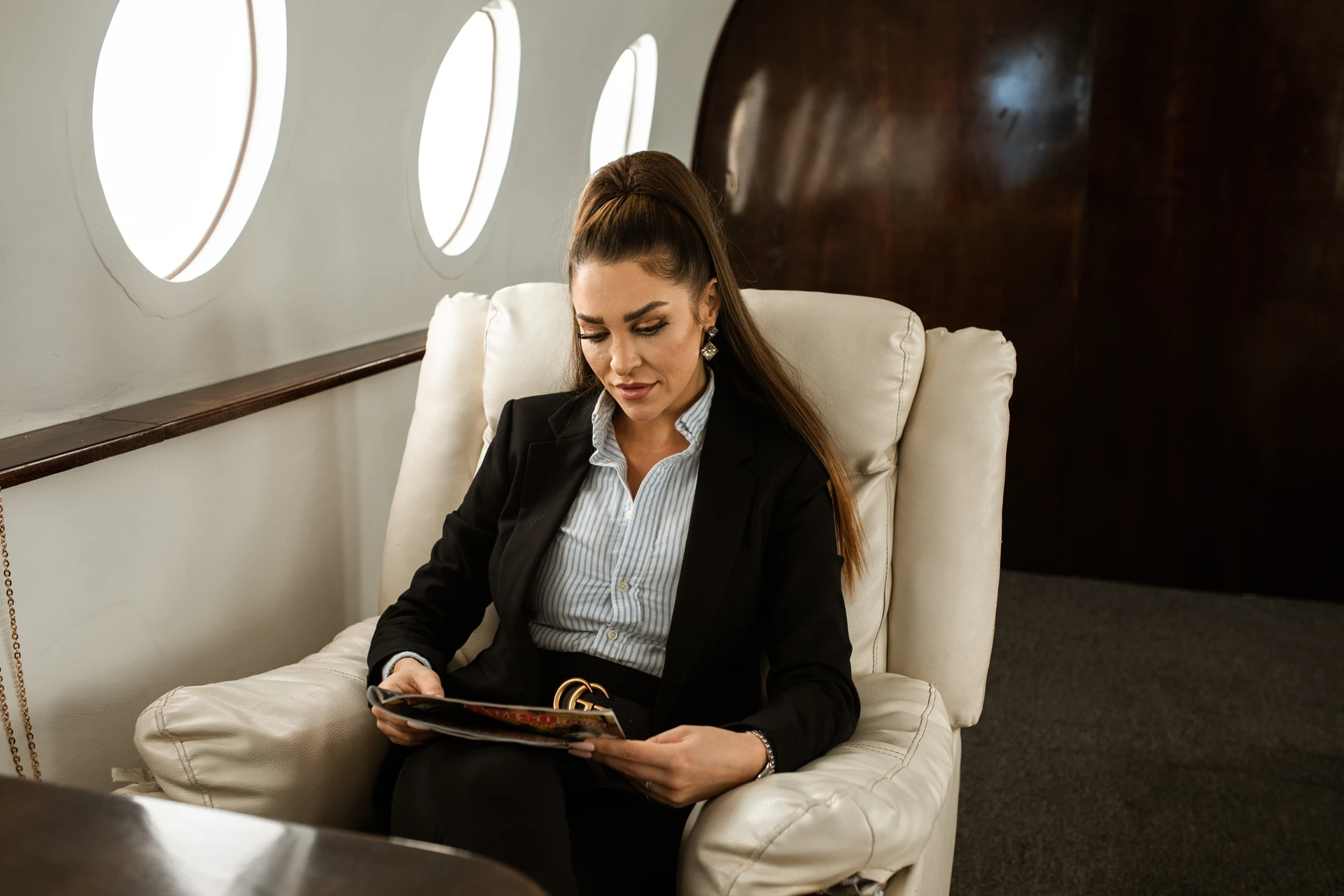
Why corporate demand for private jets has tripled in two years
According to Wing Aviation Research, the number of corporate private aircraft bookings in Europe grew 287% from early 2024 to Q1 2026. The reason is not just status. Companies discovered that for teams of four to six people flying to cities without direct flights, the cost of top managers' working hours exceeds the difference in ticket prices.
A major London consulting firm sends partners to Oslo, Copenhagen and Helsinki in one day. Commercial flights require an overnight stay and two days off. A private aircraft departs at 06:00, returns by 22:00, three meetings completed. Savings on hotels, per diems and lost time pay for the charter with five or more passengers.
Deloitte Private Aviation analysts note a shift in client profile. In 2023, 68% of bookings came from the financial sector and family offices. By the end of 2025, the share of technology companies, manufacturers and logistics holdings reached 41%. The reason is simple: remote sites, tight project deadlines, the need to transport equipment or prototypes.
Three booking models displacing traditional charter
The classic scheme - calling a broker, requesting quotes, choosing an aircraft - works for one-off flights. Corporations with regular routes are switching to subscriptions and block hours.
Fixed-rate membership is offered by NetJets, VistaJet, Flexjet. A company buys a card for 25, 50 or 100 flight hours. The hourly rate is fixed for a year, availability guaranteed with 24 hours' notice. For businesses with 8-12 flights per quarter, this reduces costs by 15-22% compared to one-off charters.
Example: a German medical equipment manufacturer bought a 75-hour package from VistaJet in January 2025. Munich - Zurich - Milan - Warsaw routes repeat weekly. Fixed price €6,400 per hour on a Challenger 350 versus €7,200-8,500 for one-off bookings. Annual savings totalled €78,000 over 120 flight hours.
Empty leg marketplaces have evolved from amateur websites into B2B tools. JetClass, Victor, Avinode publish flights that operators perform without passengers for repositioning. Discounts reach 60%, but flexibility is limited: route and time are fixed.
Travel managers integrate these platforms into the planning process. If a business trip is scheduled two weeks ahead, the system checks available empty legs. When route and window match within ±6 hours, booking is automatically offered for approval. French engineering company Assystem saved €140,000 in 2025 using empty legs for 18 of 64 charter flights.
Shared charters are gaining popularity among mid-sized companies. Platforms like Airacer, JetSmarter, Set.Jet sell seats on already-scheduled routes. Cost is comparable to business class on commercial airlines, but time savings remain: separate terminal, departure 15 minutes after arrival, unlimited baggage.
The London - Geneva route on Friday mornings is in demand from banks and hedge funds. An operator runs a weekly Pilatus PC-24 with eight seats. Price €1,850 per seat versus €950 for British Airways business class, but departure at 07:30 instead of 09:15, arrival at private terminal, office meeting by 09:00 instead of 11:30. For a three-person team, the extra €2,700 pays for itself in two hours of working time.
How to integrate private jet booking into corporate systems
Most TMCs (travel management companies) did not offer charters on a unified platform until 2024. An employee booked commercial flights through Concur or SAP, and private aircraft directly with the operator, bypassing policy and budget control.
Now Amadeus, Sabre and Travelport connect charter aggregators. A travel manager sees commercial flights, charters and empty legs in one interface. The system automatically calculates full cost: tickets, hotels, transfers, per diems, lost time.
Example policy setup: if a route requires two connections or an overnight stay, and three VP-level or higher employees are travelling, the system offers a charter as an alternative. The CFO sees a comparison: commercial option €8,400 + €1,200 hotels + 18 hours travel versus charter €14,500 + 6 hours. The decision is based on the team's hourly cost.
The key point is integration with expense tracking systems. Charter booking must go through the same approval stages as commercial flights. Otherwise shadow expenses arise: a manager orders an aircraft on a corporate card, accounting learns after the fact, quarterly budget violated.
The real economics of private jets: when the numbers add up
The cost per flight hour for a light jet (Citation CJ3, Phenom 300) in Europe ranges from €3,200 to €4,800. Medium (Hawker 800, Learjet 60) - €5,500-7,200. Heavy (Gulfstream G450, Challenger 605) - €8,000-12,000.
For the Paris - Frankfurt route (1 hour 10 minutes), a light jet costs €4,500 per aircraft. Air France business class - €650 per person. With one passenger, charter is seven times more expensive. With six passengers, cost per person is €750 - comparable to commercial flight, but with three hours saved.
Hidden advantages appear on complex routes. Brussels - Gdansk requires a connection in Warsaw or Frankfurt, total time 6-8 hours. Direct charter - 1 hour 50 minutes. For a team of four managers with an hourly cost of €200, time savings are valued at €4,800. Ticket price difference €6,000 minus saved hotels €800 gives net overspend €4,400. If the meeting is critical, the overspend is justified.
Some companies calculate cost by project, not hours. A turbine manufacturer sends engineers for emergency repairs. Each day of client downtime costs €50,000 in penalties. A charter for €18,000 delivers the team 12 hours faster than a commercial flight. Penalty savings exceed flight cost by three times.
Operational aspects: what a travel manager needs to know
Booking a charter requires more data than buying a ticket. The operator needs passport details 24 hours before departure, exact baggage weight (restrictions stricter than commercial aviation), list of prohibited items (lithium batteries, chemicals, samples).
Airport slots are not guaranteed automatically. At London Luton, Paris Le Bourget, Geneva Cointrin during peak hours (07:00-09:00, 17:00-19:00), slots are booked a week ahead. The operator may offer alternative times or a neighbouring airport. Travel managers must build buffer time into schedules.
Charter cancellation is more expensive than ticket refunds. Typical terms: cancellation 72 hours ahead - 25% loss, 24 hours - 50%, on departure day - 100%. Some operators offer cancellation insurance for 7-10% of flight cost. For critical trips, this is a sensible option.
Customs formalities are simplified but not eliminated. Flights within Schengen do not require passport control, but cargo declaration is mandatory. Flights to the UK, Switzerland, Norway undergo full control, albeit in a separate terminal. For routes to CIS countries, Turkey, UAE, advance flight permits are required, which operators process in 3-5 days.
New booking technologies: from APIs to blockchain
Aggregators like PrivateFly (acquired by Directional Aviation in 2024), Victor, JetClass provide APIs for integration into corporate systems. A travel manager sets up automatic quote requests: the system sends route, dates, passenger count to five operators, receives offers in 15 minutes.
Blockchain platforms (Winding Tree Aviation, SkyTrails) are testing smart contracts for booking. Deposits are locked in cryptocurrency, automatically transferred to the operator after flight completion. This reduces fraud risk and simplifies international payments. The technology is used in less than 2% of bookings so far, but major operators (NetJets, Flexjet) announced pilot projects in 2026.
Artificial intelligence optimises routes. The system analyses a company's quarterly business trip schedule, identifies recurring destinations, suggests subscriptions for specific routes or block hour purchases. The algorithm accounts for seasonality, fuel prices, aircraft availability.
Example: a British consulting company uploaded its Q2 2026 travel plan. The system identified 14 flights on the London - Zurich route, suggested buying a 20-hour block from a London-based operator instead of one-off bookings. Savings totalled €32,000 per quarter.
Regulatory changes and impact on corporate budgets
The European Union included private aviation in the emissions trading system (EU ETS) from January 2025. The cost per tonne of CO₂ hovers around €80. For a London - Milan flight on a Cessna Citation X, emissions are 2.4 tonnes, additional charge €192. Operators include this in hourly cost or bill it separately.
Some countries are introducing luxury taxes for private aviation. France has charged €500 for each departure from Paris, Nice, Cannes airports since April 2025. Switzerland is discussing a progressive fee based on aircraft weight. This increases European route costs by 3-7%.
Companies offset rising costs through carbon offsets. Operators offer purchase of certified offsets (Gold Standard, Verra) at booking. Cost of offsetting 2.4 tonnes of emissions - around €50, significantly cheaper than mandatory fees. Some corporations include this in sustainability policy: every charter flight is automatically offset.
Practical steps for implementing charters in corporate policy
Start with an audit of last year's routes. Identify trips where three or more employees flew on the same flight, routes with connections, business trips with overnight stays due to inconvenient schedules. These are candidates for charter replacement.
Agree on approval criteria. For example: charter permitted if time savings exceed four hours per team, or if commercial option requires overnight stay, or if three C-suite level people are travelling. Criteria must be measurable to avoid subjective decisions.
Choose two or three preferred operators or an aggregator. Sign a framework agreement with fixed rates for popular routes. This speeds up booking and simplifies accounting. The operator knows company requirements, provides priority support.
Integrate charters into reporting systems. Every flight must go through the same stages: request, approval, booking, expense report. Use the same cost codes as for commercial flights, with an additional "charter" tag. This allows analysis of effectiveness and policy optimisation.
Train employees. Many perceive private jets as extravagance and avoid requests. Explain criteria, show examples where charter is cheaper or comparable to commercial options when full cost is considered. Remove the psychological barrier.
Market forecast: what will change by the end of 2026
Argus International analysts forecast 35-40% growth in the corporate segment of private aviation in 2026. The main driver is mid-sized companies with €50-500 million revenue that previously did not consider charters.
The emergence of new light jets with extended range (Pilatus PC-24, Embraer Phenom 300E, Cessna Citation CJ4 Gen2) reduces hourly cost by 10-15% compared to previous-generation models. This makes charters more accessible for medium-range routes (1,000-2,500 km), where commercial airlines previously dominated.
Subscription models will become standard. Operators are shifting from selling hours to selling availability: a company pays a fixed monthly sum, gets guaranteed aircraft access with 12-24 hours' notice. This resembles car rental instead of taxis.
Regulatory pressure will intensify. The European Commission is discussing mandatory emissions disclosure for all private flights. Companies will be forced to include charter carbon footprints in corporate ESG reports. This will encourage selection of more efficient aircraft and operators with sustainable aviation fuel (SAF) programmes.
Checklist for travel managers: implementing charters in 90 days
First month: data analysis. Export all flights for 12 months, filter routes with connections, group trips, business trips with overnight stays. Calculate full cost (tickets + hotels + per diems + lost time). Identify 20-30 cases where charter could have been more advantageous.
Second month: negotiations with operators. Request quotes from three operators for identified routes. Compare terms: minimum notice, cancellation policy, additional fees. Sign a framework agreement with one or two operators.
Third month: pilot project. Select five upcoming trips matching criteria. Book charters, collect feedback from participants. Calculate actual time and money savings. Adjust criteria based on results.
In parallel, update corporate policy, integrate charters into booking system, conduct webinar for executives. After 90 days you will have a working system that saves time and optimises budget.
FAQ
When is a private jet cheaper than business class for a corporate trip?
Charter becomes cost-effective under three conditions: team of four or more people, route requires connections or overnight stay, employee hourly cost exceeds €150. For example, for six managers on the Brussels - Gdansk route, charter costs €750 per person versus €420 for commercial flight, but saves six hours and one overnight stay.
How to integrate charter booking into corporate systems?
Modern TMCs (Amadeus, Sabre) connect charter aggregators via API. Travel managers see commercial flights and charters in one interface, the system automatically compares full cost including hotels and lost time. Booking goes through the same approval stages as regular tickets.
What hidden costs arise when booking a private jet?
Besides hourly flight cost, account for: airport fees (€200-800), flight permits for certain countries (€150-500), EU ETS fee for CO₂ emissions (€80-300 per flight), luxury taxes in individual countries (€500 in France), cancellation insurance (7-10% of cost). In total this increases price by 10-18%.
What are empty legs and how to use them for savings?
An empty leg is a flight without passengers for aircraft repositioning. Operators sell such seats at discounts up to 60%. Platforms JetClass, Victor publish available flights 3-14 days ahead. If your route and time match an empty leg within a ±6 hour window, you can save €4,000-8,000 per flight.
What criteria to use for charter approval in corporate policy?
Measurable criteria: time savings over four hours per team, participation of three or more VP+ level employees, route requires two connections or overnight stay, commercial option unavailable at required time. Avoid subjective wording like "at manager's discretion" - this creates uncontrolled expenses.
Ready to automate business travel?
GetOffers — AI platform for corporate travel management. Save 15–30% on business travel.
Related posts
Business Class on Short-Haul Flights: Is It Worth It?
The price gap between economy and business class on short-haul flights reaches 300%. We examine the real value for corporate travel and decision criteria.
Corporate Airline Fares for Domestic Flights 2026
Negotiating discounts on domestic flights is realistic even with 15–20 tickets per month. We break down negotiation mechanics, entry thresholds, and real savings.
Premium Low-Cost Airline Fares: A New Era in 2026
Low-cost carriers are launching business fares with priority boarding and baggage for 40–60% less than legacy airlines. We analyse the economics for corporations.
Basic Corporate Airfare Rates: 2026 Financial Model
Basic corporate airfare rates cut costs by 18–35%, but hidden expenses can exceed savings. We break down the math and criteria for your travel policy.

Amadeus vs Sabre for Corporate Travel: 2026 GDS Guide
Compare Amadeus and Sabre for corporate clients: real data on costs, features, and integrations. Discover which GDS saves up to 18% of travel budgets.
Dynamic Airline Pricing: Save Up to 28% on Corporate Fares
Corporations lose up to 28% of their budget by not understanding dynamic pricing mechanics. We break down airline algorithms and tools to reduce flight costs.